
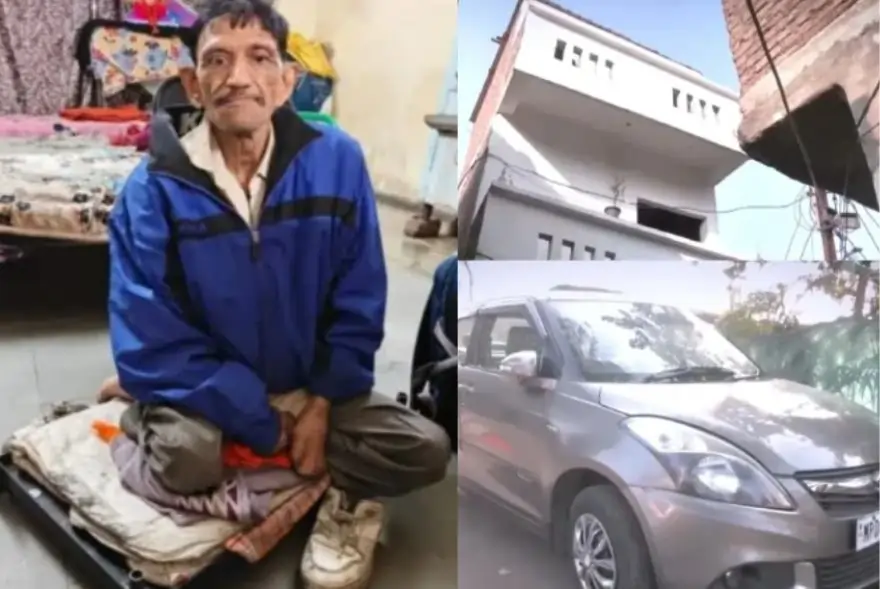
Mangilal, government officials said, started begging around 2021-22 and earns between Rs 400 and Rs 500 daily from alms alone
When Madhya Pradesh government officials arrived at Indore’s Sarafa locality late Saturday night to assist Mangilal, a physically disabled beggar, they believed they were responding to a routine humanitarian call. Reports suggested the man—allegedly a leprosy patient—was living in extreme destitution and required immediate support.
What followed over the next few hours, however, stunned even seasoned officials.
Behind the image of a helpless vagrant lay an astonishing financial reality. Mangilal, who appeared to survive on alms while resting on a wooden cart, turned out to be a wealthy property owner running a lucrative, informal money-lending operation—financed entirely through begging.
From Beggar to Property Owner

Investigations revealed that Mangilal was far from homeless. His asset portfolio includes at least three houses in a prime residential area of Indore—one of them a three-storey building and the other two single-storey homes. In addition, he owns a government-allotted one-BHK flat received under a joint initiative of the State Government and the Red Cross.
His wealth extends beyond real estate. Mangilal owns three auto-rickshaws, which he rents out for steady passive income, and a Maruti Suzuki Dzire sedan used for personal travel—despite his daily presence on the streets.
Begging as a Business Model
Officials said Mangilal began begging around 2021–22 and earns between Rs 400 and Rs 500 daily from alms alone. But the real earnings, they discovered, began after sunset.
During questioning, Mangilal admitted that begging was merely a “front” for a sophisticated informal banking system. Using his daily collections, he provided short-term, high-interest loans to traders in the Sarafa market. The loans typically ran for a day or a week, with interest collected daily.
His constant presence on the streets allowed him to discreetly recover payments without raising suspicion.
A Case of “Professional Begging”
Despite having stable housing and multiple income streams, Mangilal continued to occupy public spaces meant for the genuinely destitute—drawn by the high returns offered by the bustling Sarafa market.
Officials from the Indore Beggar Eradication Campaign described the case as a textbook example of “professional begging,” where welfare support is deliberately bypassed in favour of unregulated, untaxed earnings.
Assets at a Glance:
- Properties: 1 three-storey building, 2 single-storey houses, 1 government-allotted flat
- Vehicles: 3 auto-rickshaws (rented out), 1 Maruti Suzuki Dzire
- Daily Begging Income: Rs 400–500
- Business: High-interest money lending to local traders
Authorities are now examining legal and administrative measures to address such cases, where individuals with significant wealth exploit public sympathy and welfare systems—raising broader questions about enforcement, accountability, and the definition of destitution in urban India.
Also Read : Manipur Marks 55th Statehood Day with Grand Parade; Governor Bhalla Stresses Peace and Inclusive Growth